Jul 21, 2010

RUPERT HINE - UNFINISHED PICTURE (PURPLE 1973) Jap mastering cardboard sleeve + 1 bonus


... By 1975, Rupert Hine was already beginning to gain credibility as a producer and session musician, but he had also released two of that era's most cryptic solo albums in Pick Up a Bone and Unfinished Picture. The latter in particular demonstrated that Hine had few peers when it came to shaping elaborate instrumental textures and atmospheres without departing from a song-based format. Most listeners' overriding feeling on hearing them, however, was one of perplexity, and sales were correspondingly minuscule. But throughout his career, Hine has shown himself perfectly willing to rein in his more experimental tendencies for the sake of shifting a few more units...[allmusic]
Here

............................................
These are two of my favorite albums on this label ...The more you listen the more you love these LPs ... Whatever genre you can imagine... (prog,pop,psych,folk,singer-songwriter) is here!...listen carefully...
The tribute to "Purple Records" will continue next week possibly with two other rare & also beautiful albums (Buddy Bohn & Curtis Maldoon)
I guess the most of you, know my musical criteria very well so you don't expect me to end this tribute by posting albums like the "Silverhead" or the "Hardstuff" ..OMG!!!...lol!!!
Georgie+++

RUPERT HINE - PICK UP A BONE (PURPLE 1971) Jap mastering cardboard sleeve + 1 bonus


Although also a recording artist in his own right, Rupert Hine earned perhaps his greatest notoriety as one of the most successful and prolific producers of the synth-pop era. As half of the duo Rupert & David, he made his recording debut at the age of 16 with the 1965 single "The Sound of Silence"; it was not a success, and so he maintained a low profile until 1971, venturing out as a solo performer with the LP Pick Up a Bone. After issuing his second solo effort, 1973's Unfinished Picture, Hine turned to production with Kevin Ayers' Confessions of Dr. Dream. In 1976 he began fronting the trio Quantum Jump, debuting that year with a self-titled album and releasing the follow-up Barracuda a year later. Around 1978 he began accepting more and more production work, helming albums from Anthony Phillips, the Members and Camel, guiding the latter to their most successful effort, I Can See Your House from Here.
Here

Jul 15, 2010

JACKSON HEIGHTS - THE 5th AVENUE BUS (VERTIGO 1972) Jap DSD mastering cardboard sleeve


The second album by Jackson Heights wasn't as nondescript as many similarly obscure efforts from bands led by musicians -- in this case, ex-Nice guitarist/bassist/singer Lee Jackson -- who pretty much vanished from the limelight after their stint with a famous group. Jackson also deserved some credit for being bold enough to move into directions in which the Nice weren't associated; 5th Avenue Bus is much more oriented toward singer/songwriter-type, folk-rock songs than the Nice ever were, with little of the art rock that the Nice helped pioneer in sight. Nonetheless, the record and its songs were kind of nondescript, as mildly pleasing as some of the singing and melodies were. Often the songs used vocal harmonies with a Crosby, Stills & Nash/America flavor, though here sometimes used with mainstream early-'70s British rock arrangements, a combination that wasn't all that arresting. Other cuts like "Luxford" had a more suitable acoustic soft rock sound, though the songs themselves weren't knockouts. Ex-King Crimson drummer Michael Giles played on the record, though he didn't stretch his prog rock chops here too often, and there are only flashes here and there -- perhaps in "Sweet Hill Tunnel," and the tensely wistful parts of "Pastor Roger" -- of the somber grandeur to which the Nice had once aspired.[Richie Unterberger]
Here

Jul 5, 2010

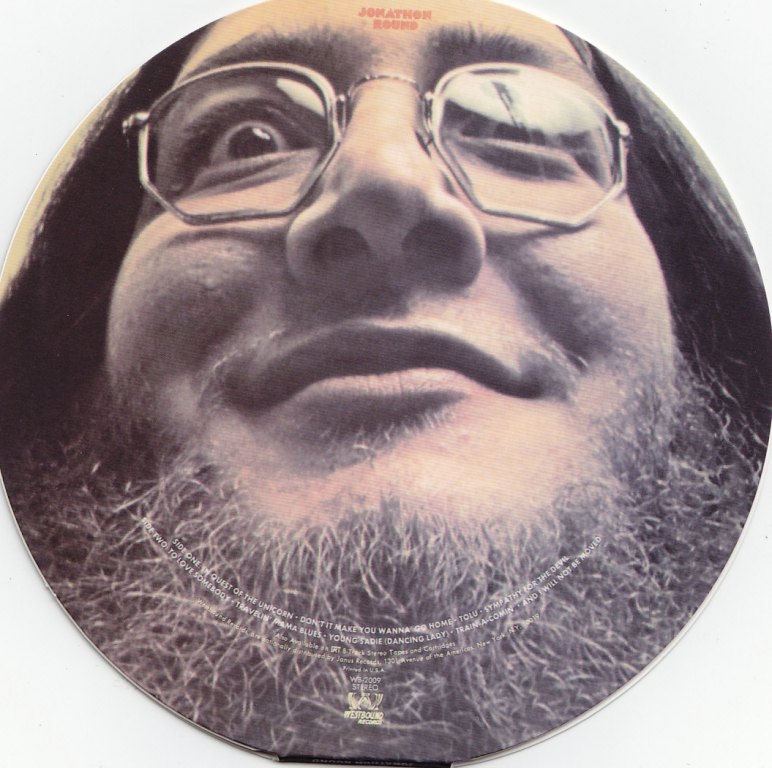
JONATHON ROUND - JONATHON ROUND (WESTBOUND 1971) Kor mastering cardboard sleeve


Overbaked cackling. Sound effects of hellish winds and thunder. Lyrics recited like a mad actor more than sung like a rock star. Wow, what a great version of "Sympathy for the Devil!"
The "Devil" was the only song that interested critics when Jonathan Round's album arrived. That is, if anybody reviewed it at all. A few also commented on Round's album actually being die-cut in a round shape, which was quite an uncommon trick. Even so, the years passed, the album disappeared, and so did the artist.
.............................
The Rolling Stones cover version is the best thing on the album, although the rest isn't bad journeyman rock. On a gospel shout like "Don't it Make You Wanna Go Home" he aims for a male Janis Joplin (modern listeners might say this ground Round sounds like Meatloaf.) The throaty soul affectations dominate the rock tunes, but on a softer folkie piece, like "Tolu" (all about "saving karma," man) he sounds like he could've been a slightly hoarse warm-up act for Gordon Lightfoot or Cat Stevens. [http://illfolks.blogspot.com/]
Here

Jul 2, 2010

JUST OTHERS - AMALGAM (PRIVATE PRESSING 1974) Kor mastering cardboard sleeve


Amalgam was recorded, making the utmost of the most basic equipment in the spring and summer of 1974. Just 250 copies were pressed, and the record was sold only at gigs. What kind of album did Just Others make? For sure, there are songs on Amalgam that manage to convey a variety of human feelings. And there is an all-pervading feeling, part optimism, part melancholy, that makes this a uniquely interesting addition to any serious collection of acoustic music of the period. The cross-fertilization between their separate enthusiasms and previous musical experience goes a long way toward explaining the uniquely distinctive blend to be heard on Amalgam. Highly recommended for fans of British folk rock including Tir Na Nog and John Renbourn.
...........................
This is a rare UK private press folk LP from 1974, only 250 made, and the record was sold only at gigs. Just Others was an English band, consisting of Geoff Twigg and Brian Rodgers. Their music is a nice blend of pop and folk with incredible lyrics, amazing voices and fine guitar work.
A REALLY GREAT ALBUM!!!
Here

STRAY - SUICIDE (TRANSATLANTIC 1971) Jap mastering cardboard sleeve


REQUEST No 5
.......................
One of the most consistent and popular bands of the 70s, Stray trod a fine line between Hard Rock, Prog, and harmony-driven Boogie, their powerful playing, hook-laden melodies and accomplished harmonies appealing equally to all three audiences. Formed in 1966 by guitarist Del Bromham, who still fronts the band today, they were originally a Mod combo, inspired by the likes of The Small Faces. They built up a reputation on the West London circuit and by the late 60s they'd moved a long way from R&B and Soul covers, eventually writing their own songs and embracing fullblown Psychedelia. By the turn of the 70s they were well established at the forefront of the Underground/Progressive circuit, with a massive following in Europe, and they continued to thrive until the Punk explosion abruptly terminated the Prog scene. After splitting in 1977 they reformed in the early 80s, and they continue to tour and record.
...........................
London, England's Stray yielded a prolific career yet managed to elude the fame enjoyed by contemporaries like Cream, Thin Lizzy, or even Mountain. Formed in 1966, the hard rock, prog, and R&B outfit comprised of vocalist/guitarist Del Bromham, vocalist/guitarist Steve Gadd, bass player Gary Giles, and drummer Ritchie Cole signed to Transatlantic Records and released its debut, self-titled album in 1970. The group flirted with success throughout the '70s, releasing nine more records and even recruiting Charlie Kray -- the brother of the notorious Kray twins -- as their manager. In 1975, just prior to the release of Houdini, Gadd was replaced by Peter Dyer, who injected some much-needed life into the band, though the end was near for the financially strapped rockers. They released their last record, the ambitious Hearts of Fire, in 1976 on the Pye label, and proceeded to splinter off into various solo projects. Bromham re-formed the group in 1997 as a three-piece with newcomers Dusty Miller and Phil McKee, renaming the band Del Bromham's Stray, and released a live record called Alive and Giggin' on Mystic Records.[allmusic]
Here

Jul 1, 2010

JULIE LONDON - YUMMY YUMMY YUMMY (LIBERTY 1969) Jap mastering cardboard sleeve


REQUEST No 4
....................
Pop standards vocalist/actress Julie London was definitely at a transitional phase in her career when she cut Yummy, Yummy, Yummy (1969) -- the final entry in her decade-and-a-half long relationship with Liberty Records. Modern listeners will revel in the obvious kitsch factor of a middle-aged, old-school female who is crooning rock & roll. Rightly so, as the two musical universes rarely collided with a lucrative outcome. However, just below the genre-bending veneer lie interesting interpretations of concurrently well-known selections with the occasional sleeper gem thrown in. The lush and admittedly antiquated orchestration doesn't mask London's smoky and smouldering pipes, and some scores definitely work better than others. The opening cover of Laura Nyro's "Stoned Soul Picnic," the adaptation of the Beatles' "And I Love Her," and the remarkably evocative "Hushabye Mountain" from Chitty Chitty Bang Bang (1968) are each superior matches of artist with repertoire. Less successful is Harry Nilsson's "Without Him" [aka "Without Her"] as it lacks the urgency of Blood, Sweat & Tears' rendering or the pithy of Nilsson's original. The remake of Spanky & Our Gang's "Like to Get to Know You" is similarly short on soul, although it lends itself to the middle-of-the-road (MOR) feel, as does "It's Nice to Be With You." That said, the latter is infinitely more tolerable in this context than it was on the Davy Jones' warbled Monkees' single. The seeming incongruity of London's take on the Doors' "Light My Fire" isn't all that odd until she lets her hair down (so to speak) and slips into something right out of The Graduate's Mrs. Robinson. There are several instances of 'What were they thinking?,' such as the practically surreal "Mighty Quinn (Quinn, The Eskimo)" which sounds like it was the result of a Quaalude-related encounter. By the time we roll around to the title track, one can't tell if London is trying to be sexy or is simply hung over. "Sunday Morning" -- the second nod to Spanky & Our Gang -- also makes London come off as either bored or sleepy, either of which will be the effect that a majority of the album will inevitably have on 21st century ears. ~ Lindsay Planer, All Music Guide
.........................
"Yummy, Yummy, Yummy," the album's title track, was a very recent Top 5 bubblegum hit for Ohio Express that featured the adenoidal vocals of the song's co-writer, Joey Levine. The listener will immediately note that, unlike the original, which sounds like a children's song, London's rendition of "Yummy, Yummy, Yummy" seems quite serious. The apparent absence of irony makes this recording an exceedingly dry joke, a visionary feat of interpretation, or both. The real irony is that "Yummy, Yummy, Yummy" has become London's second best-remembered single after "Cry Me a River"--it was reissued on one of Capitol's Ultra-Lounge compilations in the '90s and, more recently, was included on the soundtrack of the HBO television series Six Feet Under.
Here

FOLKLORDS - RELEASE THE SUNSHINE (ALLIED 1969) Jap edition


REQUEST No 3
......................
This pretty if somewhat low-key album is a nice piece of folk/sunshine pop with resonant Autoharp and guitar, a kind of reflective male/female vocal mix that recalls the first Jefferson Airplane album, and some diverting psychedelic lyrics. Not knowing the Folklords' Release the Sunshine won't make you a failure in '60s music lore or trivia, even in Canada, whence they hail, but hearing it isn't the worst way to spend 40 (or 80) minutes of your time. "Forty Second River" has a spacy quality that's pretty diverting and "Windows" a stark lyricism that's a bit like the Signe Anderson-era Airplane, before the latter's wattage got boosted. Some of it is a little on the lugubrious side ("Pardon Me Judas"), while other songs seem like potential singles ("Thank You for Your Kindness"). ~ Bruce Eder, All Music Guide
Here

THE INNOCENCE - THE INNOCENCE (KAMA SUTRA 1967) JVC K2 mastering cardboard sleeve + 3 bonus


REQUEST No 2
........................

In 1966 Peter Andreoli (aka Peter Anders) and Vincent Poncia, Jr. members of the Tradewinds changed their name to The Innocence, recorded a full-length eponymous album, and had two further hit singles, “There’s Got to Be a Word!” (U.S. #34, 1966) and “Mairzy Doats” (U.S. #75, 1967). Following the LP release the duo released another album under the name Anders & Poncia on Warner Bros. Records in 1969, and shortly after broke up. (Wiki)
Here

DAVE DEE, DOZY, BEAKY, MICK & TICH - TOGETHER (FONTANA 1969) Jap mastering cardboard sleeve + 14 bonus


REQUEST No 1
.....................

"Together", originally released in 1969, was the fourth and the last album to be released as Dave Dee, Dozy, Beaky, Mich & Tich. Throughout 1966-68 the songwriting team Howard/Blaikley had written most of their material and thus given them 10 top-twenty hit-singles. Most of these songs were really great and are still very listenable.There had been a great varity in style among these hit-singles and this trend continued on their 1969 recordings. But somehow it seems the inspiration had run dry, because, though both "Snake in the Grass" and "Don Juan" reached the 23 spot, it's like the charm and magic isn't there anymore. The Howard/Blaikley songs on "Together" are simply not up to their usual standards; a tendency which already could be sensed on the previous album.
Of course there are a few exceptions, which make the album worthwhile. "Love is a Drum" is a good song, with a great arrangement, and though "First Time Loving" is pretty light-weight it has its charm. "Run Colorado" is also okay.[Morten Vindberg-Amazon]
Here

Jun 4, 2010

DOUG RANDLE - SONGS FOR THE NEW INDUSTRIAL STATE (KANATA/CBC 1970)


A stunning collection of songs for and about the time we live in from the Canadian musician. Though the album was originally released in 1971, it's musical themes sound modern and timeless nearly 40 years after the album's original release. Songs was an introspective look at ever-dominant corporations, the cutthroat advertising world, our consumer society, decaying environment, and his own personal condition. The results crossed the epic studio creations of David Axelrod's Capitol output with Free Design vocal harmonies from notable vocalists Tommy Ambrose and Laurie Bower.
......................
This unique and curious piece of work from Canadian composer and arranger Doug Randle represents a song cycle based upon a dystopian vision of our consumerist future (or rather, our present). Each song cradles its barbed message within a package of sweet vocal harmonies and the kind of big band arrangements that would rival David Axelrod's output. "Doug was, and still is, a writer, arranger, musician, and conductor with roots deep in the Canadian jazz scene of the 1950s. After a lengthy spell working in England during the first half of the 1960s, he returned to Toronto and took up an in-house position at the government sanctioned Canadian Broadcasting Corporation (CBC), where in 1970 he recorded his very own What's Going On. Commercially released by the short-lived Kanata Records label, Songs was an introspective look at ever-dominant corporations, the cutthroat advertising world, our consumer society, decaying environment, and his own personal condition."[boomkat]
A Great Pop-Psych Album...don't miss it!

Here

MILLER ANDERSON - BRIGHT CITY (DERAM 1971) Kor mastering cardboard sleeve


Songwriter, vocalist and guitarist Anderson first came to promenance in the late 60s as a member of the jazz/rock unit the Keef Hartley Band. Anderson grew in stature as a member of that band and was present for five albums. He was signed by Deram as a solo artist and released one credible album, Bright City, in 1971. Many of his former Hartley sidemen were present on the album, including record producer Neil Slaven. Junior Campbell arranged some exquisite strings for the title track and there was beautiful flute from Lynn Dobson on ‘Shadows ’Cross My Wall’. Following this album Anderson formed Hemlock with James Leverton (bass) and Eric Dillon (drums), who made one album with Deram. Anderson teamed up with Hartley in 1974 as Dog Soldier and also had spells with Savoy Brown, Canned Heat and T. Rex. He continues to perform regularly in the UK and Europe and in the mid-90s the re-release of his album on CD, together with a reissued Hartley catalogue, indicated that his star was in the ascendant. His present solo act features an excellent version of Bob Dylan’s ‘Copper Kettle’, but his finest moment is a blistering acoustic version of ‘Don’t Let Me Be Misunderstood’; his voice on this track can strip wallpaper and break lightbulbs. In 1997 Anderson was touring with a revamped version of the Spencer Davis Group.[Source: The Encyclopedia of Popular Music by Colin Larkin.]
Here

JOE SOAP - KEEP IT CLEAN (POLYDOR 1973) Kor mastering cardboard sleeve


Joe Soap was a band comprised of John Tennent and David Morrison. Their second album, "Keep It Clean" (as Joe Soap) (Polydor 1973) featured Jimmy McCulloch (guitar, Stone the Crows) Jerry Conway (drums, later in Jethro Tull) and Mike Kaminski (violin, from ELO).
The album features ten tracks composed by John and David with help of Sandy Robertson (producer). Two guys with rather thick but fascinating voices diffuse strong masculine beauty in all tracks. In addition to it, a mastermind violinist Mike Kaminski's scattering violin features on most of the tracks especially on Feel Strange and On The Wing are just superb. Jimmy McCulloch's intense guitar domains on every track as well. Overall, the album is an awesome combo set of typical British rock classics with strong American southern rock flavor.
........................
John Tennent and David Morrison's second and last effort (as JOE SOAP) after the first album released previous year. With support of best British studio musicians, Keep It Clean slightly differs from Tennent & Morrison. Backing up piercing electric guitar and intense violin, the album is way solid but it also has thick and moody moments appeared on the first album. First time on CD. Paper Sleeve Mini Vinyl LP Replica with OBI, Liner Note Included, 24 Bit Digital Remastering.
Here

May 17, 2010

RENAISSANCE - ILLUSION (ISLAND 1971) Jap mastering cardboard sleeve + 4 bonus


The second Renaissance album is the least-known in the group's entire output, having originally failed to get released anywhere except Germany. Although it is a much less bold, more smoothly commercial album, Illusion was also the work of at least three distinctly different lineups representing the group, Jim McCarty dropping out from playing after an illness, and Keith Relf and Louis Cennamo exiting the performing lineup soon after, while Jane Relf played some gigs with John Hawken acting as leader of a new ensemble. It was around this time that the words of lyricist Betty Thatcher started turning up in the group's work and on this album, and guitarist Michael Dunford started writing as well. The results here aren't quite as hard rocking as the previous album -- acoustic guitars supplant electric and Jane Relf's vocals are hooked around a mix of art rock and art pop melodies, without any trace of the psychedelic or freakbeat echoes of the previous album's work. One song, "Mr. Pine," contains an instrumental bridge that Dunford later folded into "Running Hard" in a more developed guise. The lighter textures anticipate the sound of the later lineup of the group, while some of the pop-oriented material harkens back to what Relf and McCarty had in mind for a sound in 1969.~ Bruce Eder
Here

Apr 27, 2010

THE MILLENNIUM - BEGIN (COLUMBIA 1968) Jap mastering Blu-Spec CD + 9 bonus


Begin is the only album ever released by the collective known as The Millennium during its lifetime (though there have been several compilations since the group's demise).
Begin has gained notoriety throughout the years as being the most expensive album that Columbia Records had released by that time, though critics generally agree that the money was well spent. It is now generally considered to be a classic of sunshine pop.
.............................
Influenced by psychedelia and California rock, pop/rock producer Curt Boettcher (the Association) decided to assemble a studio supergroup who would explore progressive sounds in 1968. Millennium's resultant album would find no commercial success and only half-baked artistic success, but nonetheless retains some period charm. Influenced in roughly equal measures by the Association, the Mamas and the Papas, the Smile-era Beach Boys, Nilsson, the Left Banke, and the Fifth Dimension, Boettcher and his friends came up with a hybrid that was at once too unabashedly commercial for underground FM radio and too weird for the AM dial. It would have fit in better on the AM airwaves, though; the almost too-cheerful sunshine harmonies and catchy melodies dominate the suite-like, diverse set of elaborately produced '60s pop/rock tunes. ~ Richie Unterberger, All Music Guide
Here